
Summary
SMS and WhatsApp solve different communication tasks. SMS is useful for concise notifications without requiring a particular app; WhatsApp supports richer conversations and interactive customer journeys. Pick the channel around the customer's task, availability and eligibility, not a universal claim that one is better. A fallback needs its own deliberate rules, and cost comparisons should include the completed customer task as well as message charges.
- Use the customer's task to choose between a concise alert and a richer conversation.
- Check the requirements and availability of each channel independently.
- Do not treat failure on one channel as permission to send marketing on another.
The AI platform opens separately. Its account and access requirements apply.
Copy this prompt manually:
Your prepared article prompt will appear here.
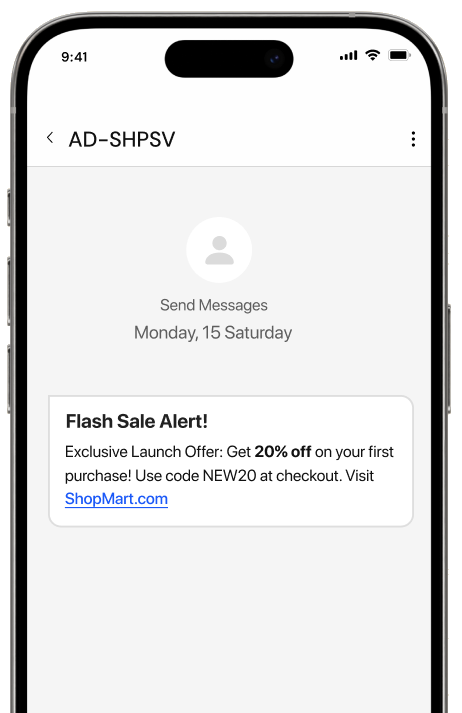
SMS is suited to concise alerts, OTPs and messages that should not depend on a particular app.
Bulk SMS and WhatsApp serve different business messaging needs. SMS is strong for broad reach, OTPs, alerts and messages that should not depend on a specific app. WhatsApp is stronger for rich two-way conversations, media, interactive journeys and customer support.
Key takeaways
- SMS does not require the recipient to install a specific messaging app.
- WhatsApp supports richer media and more interactive conversations.
- SMS is commonly used for OTPs, reminders and critical alerts.
- WhatsApp is well suited to sales, support and conversational commerce.
- Many businesses get better results by using both channels together.
What is Bulk SMS?
Bulk SMS is the large-scale delivery of text messages through a messaging platform or API. Businesses use it for promotional campaigns, service notifications, transactional alerts and authentication.
What is WhatsApp Business messaging?
WhatsApp Business messaging allows approved businesses and solution providers to communicate with customers through WhatsApp using structured templates, interactive messages and two-way conversations subject to the platform's policies and messaging rules.
Bulk SMS vs WhatsApp: reach
Standard SMS can reach mobile phones without requiring the recipient to have a specific messaging application. WhatsApp requires the customer to use WhatsApp and have a data connection.
Bulk SMS vs WhatsApp: rich media
SMS is primarily text-oriented, while WhatsApp can support images, documents, buttons and richer conversational interactions. If the customer needs to browse, respond or complete a guided journey, WhatsApp may be the stronger experience.
Bulk SMS vs WhatsApp: OTP and alerts
SMS remains widely used for authentication and time-sensitive alerts. WhatsApp can also support business notifications, but the correct channel depends on customer availability, use case, policy and fallback requirements.
Bulk SMS vs WhatsApp: customer support
WhatsApp is usually more suitable for ongoing two-way support because conversations can continue naturally and include richer content. SMS can support replies in some configurations, but it is often used primarily for one-way or simple notification flows.
Bulk SMS vs WhatsApp: automation
Both channels can be automated using APIs. The architecture differs, but businesses can trigger messages from CRM, ecommerce and internal systems based on customer events.
When should you use SMS?
- OTP and authentication.
- Urgent service alerts.
- Appointment and payment reminders.
- Communication that should not depend on an app.
- Broad text-based reach.
When should you use WhatsApp?
- Two-way sales conversations.
- Customer support.
- Rich-media product communication.
- Interactive buttons and guided journeys.
- Conversational automation.
Why a multichannel strategy is stronger
Customers do not respond to every channel in the same way. A business may send an OTP by SMS, continue support on WhatsApp, use RCS for a branded campaign and use Voice for an urgent interaction. Channel selection should follow the job the message needs to do.
How ProAds supports both channels
ProAds brings SMS together with WhatsApp, RCS and Voice so teams can plan communication across channels rather than managing isolated tools.
Choosing a channel for a customer journey
A login code often suits SMS because it can reach mobile phones without a specific app. A product enquiry or support case may suit WhatsApp because it supports interactive conversations and richer content. Delivery updates can work on either channel depending on preferences and operational setup.
A fallback workflow should respect the customer's eligibility and the rules of each channel. Compare cost per completed customer task, not only price per submitted message.
Practical example
Map the business event, eligible recipient, approved content, sending route and delivery-report state before scaling. Keep this workflow documented so marketing, compliance and engineering teams can review it.
Common mistakes
- Confusing API acceptance with handset delivery.
- Reusing a template without verifying the intended message category.
- Automatically retrying after timeouts without duplicate prevention.
- Reporting submitted volume as a proven customer outcome.
What to check before rollout
- Confirm the correct message category and recipient eligibility.
- Validate the sender and template configuration.
- Test the complete message with real variable values.
- Confirm how delivery states are recorded.
- Review the results before expanding volume.
Official reference: Verify current Indian business SMS obligations using TRAI advice to senders and the TCCCPR framework. Provider-specific procedures can change.
Quick reference comparison
| Element | What it means | Practical action |
|---|---|---|
| Reach | No specific app required | WhatsApp app and connectivity required |
| Interaction | Simple text | Rich conversational journeys |
| Typical fit | OTP, alerts, reminders | Sales, support, interactive flows |
Use this table as a planning aid. Actual requirements depend on the use case, provider and applicable rules.
Frequently asked questions
Is WhatsApp replacing SMS?
No. The channels overlap in some use cases but have different strengths. SMS remains useful where app-independent reach, authentication or simple alerts matter.
Can a business use SMS as a fallback for WhatsApp?
Yes, where the business workflow, consent, provider setup and applicable rules support that design.
Which channel is cheaper?
There is no universal answer. Pricing depends on traffic type, destination, provider, platform model and use case. Compare total communication cost rather than a single unit rate.
Related guides

WhatsApp is stronger for rich, two-way conversations, support and guided customer journeys.
Need a Bulk SMS platform?
Run promotional, transactional and OTP SMS workflows with APIs and delivery reporting from ProAds.
Explore ProAds Bulk SMS