
Summary
Bulk SMS is a way to submit business text messages through a dashboard or API. A useful setup starts with the purpose of the message, an eligible audience and the required sender and template configuration. Track request acceptance, later delivery reports and customer outcomes separately. Choose a provider around that complete workflow rather than treating the number of messages submitted as proof of success.
- Use a dashboard for managed campaigns and an API for event-triggered notifications.
- Complete the sender, template and recipient-eligibility checks that apply to the route.
- Distinguish submission, delivery and the customer action you wanted to achieve.
The AI platform opens separately. Its account and access requirements apply.
Copy this prompt manually:
Your prepared article prompt will appear here.
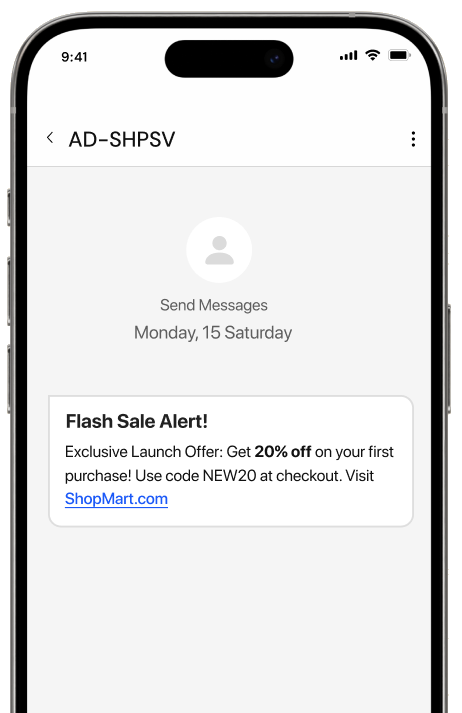
SMS is designed for broad text-message reach without requiring a separate messaging application.
See How Different SMS Types Read
Choose a use case to preview how the purpose, trigger and message style change.
- Purpose
- Encourage an eligible marketing action
- Typical trigger
- Campaign audience and schedule
Bulk SMS is the process of sending promotional, transactional, OTP, or service text messages to large groups of recipients through an SMS platform or API. Businesses use it for alerts, reminders, authentication, marketing campaigns, payment updates, order notifications, and customer communication.
Key takeaways
- Bulk SMS can be sent through a web dashboard or API.
- Recipients do not need a mobile app to receive a standard SMS.
- Common use cases include promotional campaigns, service alerts, transactional updates and OTP authentication.
- In India, commercial messaging is subject to the applicable telecom and commercial communication rules.
- Delivery reports help businesses understand message outcomes.
How does Bulk SMS work?
A business prepares a recipient list or triggers a message from an application. The SMS platform processes the message, submits it through the appropriate telecom route, and the operator attempts delivery to the recipient's mobile number. Delivery status can then be returned to the platform or business application.
- Create or trigger the message.
- Use the appropriate registered sender identity and approved content where required.
- Submit the SMS through the platform or API.
- The telecom network attempts delivery.
- Review delivery reports and follow up where necessary.
Types of Bulk SMS
Promotional SMS
Promotional SMS is used for eligible marketing communication such as offers, launches, events and campaigns. Businesses should send marketing communication only where the recipient and message are eligible under applicable consent and regulatory requirements.
Transactional and service SMS
Transactional or service SMS is used for operational communication such as order confirmations, payment alerts, appointment reminders, account notifications and delivery updates.
OTP SMS
OTP SMS delivers one-time passwords for authentication and verification. Typical use cases include login verification, transaction authorization, account recovery and phone-number verification.
What is DLT in Bulk SMS?
India's commercial messaging ecosystem uses distributed-ledger-based registration processes for entities, headers, templates and other controls. Operational requirements can change, so businesses should verify the current requirements before launching campaigns.
What is an SMS Sender ID?
A sender ID is the identity displayed to the recipient as the sender of a business message. For regulated business messaging in India, sender identities and message content may need to follow the applicable registration and approval framework.
What is an SMS API?
An SMS API lets an application trigger messages automatically. A website, CRM, ERP, ecommerce platform or mobile application can call the API when a business event occurs, such as a login, order, payment or appointment.
Common Bulk SMS use cases
- Ecommerce: order confirmations, shipping alerts and payment notifications.
- Banking and financial services: authentication and account alerts.
- Healthcare: appointment reminders and service notifications.
- Education: fee reminders, exam notices and admissions updates.
- Retail: eligible promotional campaigns and store notifications.
Bulk SMS vs WhatsApp vs RCS
SMS is strongest when broad reach and simple delivery matter. WhatsApp is better suited to rich two-way conversations, while RCS supports branded rich messaging on compatible devices and networks. Many businesses use more than one channel instead of treating them as substitutes.
How ProAds handles Bulk SMS
ProAds combines promotional, transactional and OTP SMS workflows with campaign management, APIs and delivery reporting. SMS sits alongside WhatsApp, RCS and Voice so businesses can choose the most suitable channel for each customer interaction.
What affects Bulk SMS pricing?
Pricing can vary based on message category, destination, route, monthly volume, telecom requirements, API needs and commercial agreement. The cheapest headline rate is not always the best indicator of delivery quality, support or reporting capability.
How to choose a Bulk SMS provider
- Evaluate delivery reporting and operational transparency.
- Check DLT and compliance support for India.
- Review API documentation, authentication and webhook support.
- Confirm scalability for expected traffic.
- Assess support, onboarding and multichannel capabilities.
An order notification from event to handset
A store records an order shipment. Its backend selects an approved service template, inserts the order reference and sends a request to the SMS provider. The provider acknowledges the request, then supplies a delivery status if available. The store records that status against the order. The API acknowledgement is not proof of delivery.
An eligible marketing campaign follows a different workflow: the team selects recipients, verifies permissions and preferences, uses the relevant promotional template and measures campaign outcomes separately from network delivery.
Practical example
Map the business event, eligible recipient, approved content, sending route and delivery-report state before scaling. Keep this workflow documented so marketing, compliance and engineering teams can review it.
Common mistakes
- Confusing API acceptance with handset delivery.
- Reusing a template without verifying the intended message category.
- Automatically retrying after timeouts without duplicate prevention.
- Reporting submitted volume as a proven customer outcome.
What to check before rollout
- Confirm the correct message category and recipient eligibility.
- Validate the sender and template configuration.
- Test the complete message with real variable values.
- Confirm how delivery states are recorded.
- Review the results before expanding volume.
Official reference: Verify current Indian business SMS obligations using TRAI advice to senders and the TCCCPR framework. Provider-specific procedures can change.
Quick reference comparison
| Element | What it means | Practical action |
|---|---|---|
| Service alerts | Triggered by a customer or operational event | Order and appointment updates |
| Promotional | Marketing to eligible recipients | Offer or product launch |
| Authentication | Triggered by verification request | One-time code |
Use this table as a planning aid. Actual requirements depend on the use case, provider and applicable rules.
Frequently asked questions
Does Bulk SMS require internet?
The recipient does not normally need mobile data to receive a standard SMS. The sending business may use an internet-connected dashboard or API to submit the message.
Can Bulk SMS be integrated with a CRM?
Yes. When the provider supports APIs and webhooks, SMS can be connected to CRM, ERP, ecommerce and other business systems.
Is Bulk SMS still useful in India?
Yes. SMS remains useful for authentication, alerts, reminders and communication that should reach a broad range of mobile phones without requiring a specific app.
Related guides
- DLT Registration for SMS in India
- Promotional SMS vs Transactional SMS
- SMS API Complete Guide
- What Is OTP SMS?
- Bulk SMS Pricing in India
Need a Bulk SMS platform? Explore ProAds Bulk SMS.
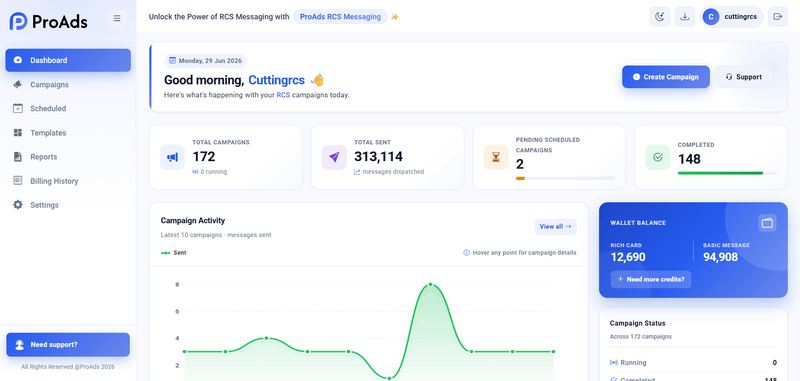
A centralized dashboard helps teams manage campaigns, templates and delivery reporting.
Need a Bulk SMS platform?
Run promotional, transactional and OTP SMS workflows with APIs and delivery reporting from ProAds.
Explore ProAds Bulk SMS